×

BC COURT RULES IN FAVOUR OF CATHOLIC HOSPITALS WHO REFUSE M.A.I.D.

BC COURT RULES IN FAVOUR OF CATHOLIC HOSPITALS WHO REFUSE M.A.I.D.

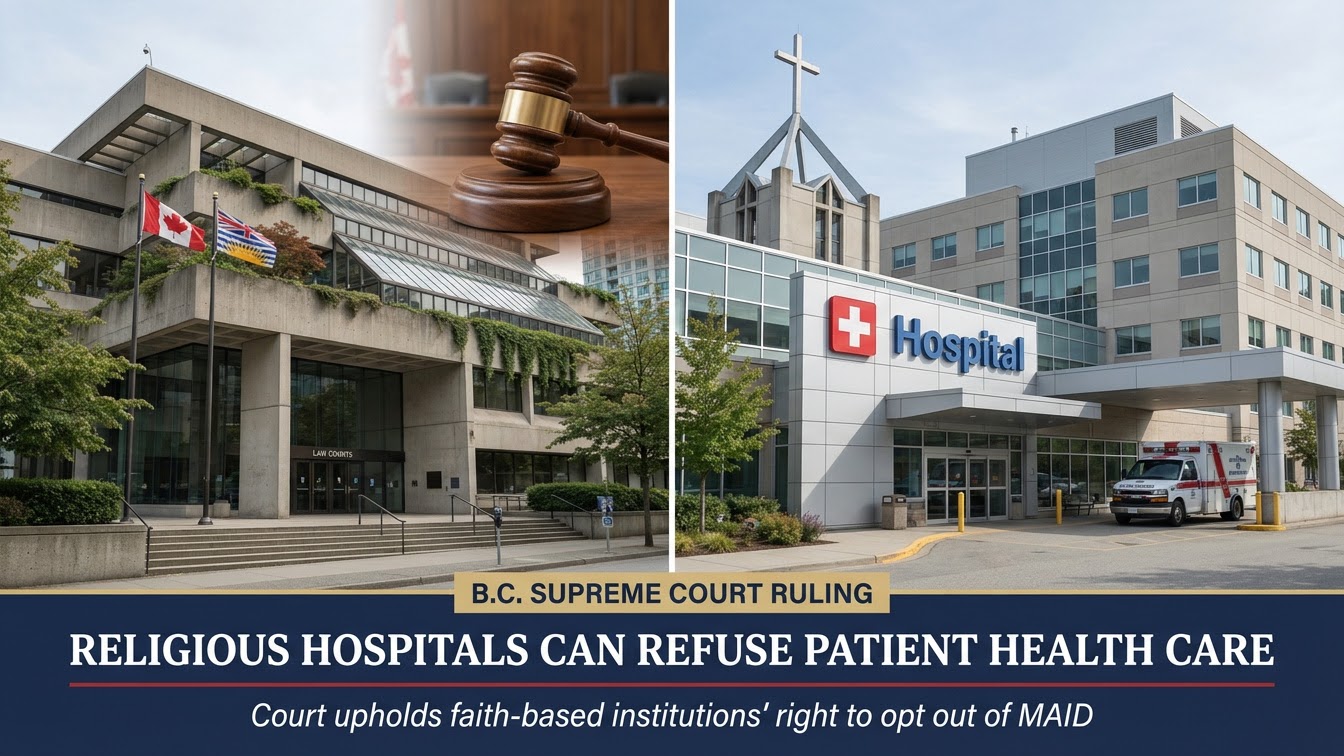
In a decision supporting the right of St. Paul’s Hospital to refuse medical assistance in dying (MAiD) on site, the B.C. Supreme Court ruled Friday that government policies allowing faith-based hospitals to decline to provide MAiD do not violate the Canadian Charter of Rights and Freedoms.

In an 86-page decision released Nov. 27, Chief Justice Ronald A. Skolrood dismissed the constitutional challenge to the province’s policy.

The government’s policy allowing faith-based organizations to operate in a way that is consistent with their beliefs “does not amount to state sponsorship of those beliefs or make the practice of those beliefs mandatory,” Skolrood wrote.

In the ruling, Providence Health Care (PHC) is described as playing “an essential role in the delivery of healthcare services within BC’s public healthcare system.”

The court acknowledged that “the delivery of healthcare services, particularly to vulnerable members of the population, is an integral part of PHC’s Catholic identity and mission” and accepted the “uncontradicted evidence of PHC that the use of its facilities is directly tied to its religious mission.”

Furthermore, Skolrood specifies that evidence did not establish that patients were being denied access to MAiD. Rather, the four patients in the case were transferred out of the care of St. Paul’s and able to access MAiD either the same day or within a short time after they made their choice.

Because no rights were violated, the court didn’t need to decide whether Providence possesses its own religious freedom rights, or whether the Charter applies to its policy.

In a statement, a Providence spokesperson thanked the parties, the interveners and the court for their “thoughtful consideration given to this important and complex issue.”

“Providence respects the BC Supreme Court’s decision,” says the statement. “We are committed to continuing to build on our 130-plus-year history of providing compassionate, exceptional and innovative health care to British Columbians.”

The case, Gaye O’Neill et al. v. His Majesty the King in Right of the Province of British Columbia, Vancouver Coastal Health Authority, and Providence Health Care Society, arose from the death of a terminally ill woman who sought medical assistance in dying (MAiD) while receiving care at St. Paul’s Hospital in Vancouver.

Because St. Paul’s is a Catholic facility that does not provide euthanasia or assisted suicide, the patient was transferred by Vancouver Coastal Health Authority to another health-care facility that offered MAiD. Her family and co-plaintiffs allege the transfer caused “considerable pain and distress,” and argue that the policy allowing faith-based facilities to opt out of providing MAiD violates the Canadian Charter of Rights and Freedoms.
The co-defendants in the case were the Providence Health Care Society, the Catholic denominational organization that operates St. Paul’s Hospital and 17 other facilities, the B.C. Ministry of Health, and the Vancouver Coastal Health Authority.

The plaintiffs also included the pro-MAiD organization Dying with Dignity and a palliative care doctor who chose not to work at a Catholic hospice because MAiD is not provided on site.

While the legality of MAiD itself was not at issue in the case, the court needed to decide whether publicly funded, faith-based hospitals can maintain MAiD-free spaces or whether the state’s duty to provide access overrides institutional conscience rights.

Central to the defence was the 1995 Master Agreement between the B.C. government and denominational health providers. The agreement formally recognizes the right of faith-based facilities to preserve the spiritual nature of the facility and governs how services incompatible with a facility’s religious identity are handled, typically through transfer rather than on-site provision.

Providence Health Care has long maintained pro-life policies that prohibit abortion and euthanasia from being performed on its premises.

Providence Health Care’s lawyer, Geoffrey Cowper, KC, argued that the case is fundamentally about balancing patients’ access to MAiD with the religious freedom of faith-based health-care institutions. He says Providence’s ability to decline MAiD demonstrates the value of a pluralistic health-care system in which Catholic institutions can provide care to everyone while maintaining their religious identity.

Cowper also argued that receiving public funding does not make Providence a government institution or program. His position is that Providence has an institutional right to freedom of religion because its hospitals are an essential part of the Catholic Church’s ministry. He rejects the plaintiffs’ characterization of Providence as essentially a government-run facility that has merely been given responsibility for managing hospital buildings.

Cowper argued that the plaintiffs understated Providence’s relationship with its hospitals, emphasizing that Providence owns and controls them. In his words, “It’s our hospital. We own it, we control it,” and he said Providence operates them not only because it is legally permitted to, but because that is what the provincial health ministry directs it to do.

Important to note, throughout the court proceedings, the quality of care offered by St. Paul’s Hospital was never in question, nor was the general practise of transferring patients from one health care facility to another – a common occurrence – under scrutiny. Plaintiff Gaye O’Neill told B.C. Supreme Court that the medical staff who cared for her daughter, Sam O’Neill, for the years she needed care, were “good to her” and were respectful of her choices, including her decision to receive MAiD.

During cross-examination, O’Neill said her daughter was fiercely independent and wanted to make her own medical decisions. She learned that Sam had decided to access MAiD and that a plan had been developed with her care team for her care to be transferred to a Vancouver Coastal Health Authority facility.

O’Neill described a rushed transfer that meant loved ones had “minimal” time for a quick farewell in groups of five. O’Neill agreed that nurses were following Sam’s directions as to who came into her room, and that there was time pressure because the transfer vehicle was waiting.

Her daughter was sedated for the transfer and was unconscious when she left St. Paul’s and when she arrived at the Vancouver Coastal Health Authority facility where she received MAiD.

She described the day as “very out of control” for her, while agreeing that all the medical decisions were made by Sam.

Ultimately, Skolrood specifies that this testimony was of limited utility to the court. “Without intending to diminish the legitimacy of the concerns and the profound sense of distress experienced by family members and friends, there are limitations on the utility of this evidence in analyzing the alleged breaches of the patients’ individual rights,” reads the ruling.

He concluded that the plaintiffs had failed to establish violations of physicians’ freedom of conscience or patients’ rights to freedom of conscience and religion, life, liberty, and security of the person.

“In my respectful view, the plaintiffs have not established any basis for the Court to interfere in that Policy,” he wrote.

With Canadian Catholic News files.

Post Comment